
Two Alembics may look similar at first glance.
The same capacity. The same shape. The same main material: copper.
But that doesn’t mean they are the same products.
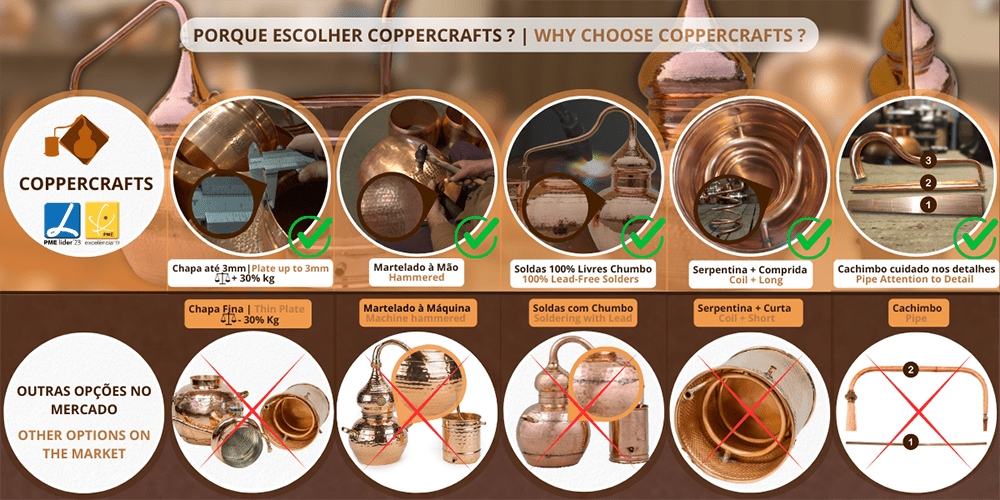
In fact, the capacity in litres is only part of the story. The true quality of a still lies in its construction: in the purity of the copper, the thickness of the sheet metal, the type of soldering, the finish, the craftsmanship and the overall durability of the equipment.
That is why two 30-litre stills, for example, can vary greatly in price.
The difference isn’t just in the litres. It’s in the build.
1. The quality of the copper makes all the difference
Copper is one of the most highly valued materials in distillation due to its excellent thermal conductivity and its role in the vapour purification process.
However, not all copper is of the same quality.
At CopperWorks, we use high-purity copper, which is suitable for the manufacture of distillation equipment for the food industry. This choice contributes to better thermal performance, greater safety and increased durability of the equipment.
A Alembic still should not be judged simply on the basis that it is made of copper, but rather on the quality of the copper used.
2. The thickness of the sheet affects durability and thermal stability
One of the most important factors, but also one of the hardest to judge from an online photograph, is the thickness of the copper plate.
A thicker copper plate tends to offer:
- greater resistance;
- greater durability;
- less wear and tear;
- more even heating;
- better thermal stability during distillation
A Alembic still made from thinner copper may look similar, but its strength, thermal properties and lifespan can be quite different.
Por isso, quando se compara apenas capacidade e preço, está-se a ignorar um dos fatores mais importantes da qualidade real do equipamento.
3. Welds are essential for safety and reliability
The welds are a critical part of a Alembic still.
At CopperWorks, our solder is 100% lead-free and meets high standards of food safety and technical quality.
This detail is essential, because a still comes into contact with steam, condensate and the final product. The safety of the materials used must not be overlooked.
In addition, a good weld helps to:
- better seal;
- greater structural strength;
- menor risco de fugas;
- greater confidence when using it.
4. The artisanal process adds real value
A handcrafted Alembic still is not merely a functional object. It is a piece crafted with technical expertise, manual skill and attention to detail.
At CopperWorks, every piece is crafted in Portugal by artisans specialising in the art of working with copper.
The artisanal process allows for:
- greater attention to detail;
- more refined finishes;
- tailored to the customer’s needs;
- preservação de técnicas tradicionais;
- greater product authenticity.
This type of manufacturing requires time, expertise and skilled labour. Naturally, this is reflected in the final price.
5. The finish is not just about aesthetics
The finish of a Alembic still says a lot about how it was built.
Details such as hand-hammering, the symmetry of the shapes, the precision of the joints and the final polish are not merely visual elements. They convey care, expertise and precision in the craftsmanship.
A good finish conveys:
- perceived quality;
- attention to detail;
- promotion of traditional crafts;
- greater confidence in the product;
- differentiation from generic products.
In a market where Many products look similar in photographs, os detalhes fazem toda a diferença.
6. Quality affects distillation performance
The design of a still has a direct impact on the user experience.
The thickness of the copper, the quality of the joints, the precision of the assembly and the thermal stability can all affect control of the distillation process.
Well-built equipment helps to ensure:
- more even heating;
- greater control over the process;
- greater stability during use;
- greater durability over the years;
- a more professional and secure experience.
Therefore, the price of a still should be viewed as an investment, not merely as an initial cost.
7. Cheap can end up costing you
A cheaper still might seem like a good choice at the time of purchase.
However, in the medium and long term, it is important to bear in mind:
- shorter lifespan;
- possible deformation of the copper;
- lower finishes;
- lower thermal stability;
- greater risk of leaks;
- lowest resale value;
- need for more frequent replacement.
When equipment is built to last for decades, its true cost must be assessed over its entire service life.
Um produto mais barato pode custar menos hoje. Mas um produto melhor construído pode compensar durante muitos anos.
8. Porque um CopperWorks custa mais?
Na CopperWorks, cada alambique é fabricado com foco em qualidade, segurança e durabilidade.
Our equipment stands out for:
- handcrafted in Portugal;
- high-purity copper;
- 100% lead-free solder;
- thicker copper sheets;
- hand-hammered finish;
- attention to detail;
- sturdy construction;
- long service life;
- extensive experience in the art of working with copper.
We don’t manufacture stills simply to compete on price.
We manufacture for customers who value genuine quality, authenticity, safety and performance.
See the differences in practice
Not all differences are visible in a photograph.
In this video, we highlight some of the technical and construction details that set a genuine handcrafted copper still apart.


Conclusion: the difference isn’t in the litres
Two Alembic stills may have the same capacity. But they are not built in the same way.
The quality of the copper, the thickness of the sheet metal, the type of soldering and the craftsmanship directly influence the durability, thermal stability and final quality of the distillation.
At CopperWorks, every piece is built to last for decades, not just a few seasons.


